

Every Reformed and Presbyterian church order gives the council (the consistory, the session or the kerkraad) the same core duties. The council governs with the minister, visits the members and keeps the membership records. It guards the Lord's Supper, transfers members to other churches, gives account to the broader assembly and exercises discipline.
The numbers differ in each federation. This guide shows where five church orders put each duty, and ends with a checklist that you can print. Check each point in your own church order.
Contents14 sections
Where do the church orders come from?
Scripture comes first. The New Testament shows elders in every church (Acts 14:23; Titus 1:5) and deacons who serve those in need (Acts 6:1-6). For a private sin, the church orders follow the rule of Matthew 18 (Dort, art. 72; CanRC, art. 66; URCNA, art. 52). Two families of church order grew from this root:
- The continental Reformed family. The National Synod of Dordrecht signed its church order on 28 May 1619. The Gereformeerde Kerke in Suid-Afrika (GKSA), the Canadian Reformed Churches (CanRC) and the United Reformed Churches in North America (URCNA) have orders in this family.
- The Presbyterian family. The Westminster Assembly wrote the Form of Presbyterial Church-Government (1645). It names pastors, teachers, other church-governors and deacons, and three sorts of assembly: congregational, classical and synodical. The Orthodox Presbyterian Church (OPC), the Presbyterian Church in America (PCA) and the Igreja Presbiteriana do Brasil have orders in this family.
Most GKSA articles keep the Dort number and subject. The CanRC order of 2025 has 76 articles, and the URCNA order (tenth edition, 2024) has 66. The OPC and the PCA use chapters and sections. We cite the OPC Form of Government (FG) and Book of Discipline (BD), and the PCA Book of Church Order (BCO, 2025).
| Church order | Local council | Broader assembly | Transfer document |
|---|---|---|---|
| Dort (1619) | consistory (art. 37) | classis (art. 41) | certificate of dismission (art. 82) |
| GKSA | kerkraad (art. 37) | klassis (art. 41) | attestaat (art. 82) |
| CanRC (2025) | consistory (art. 38) | classis (art. 44) | attestation (art. 62) |
| URCNA (2024) | consistory (art. 21) | classis (art. 26) | official letter (art. 64) |
| OPC | session (FG XIII.4) | presbytery (FG XIV) | letter of transfer (BD II.B.3) |
| PCA (2025) | session (BCO 12-1) | presbytery (BCO 13) | certificate of dismission (BCO 46-1) |
Caution: federations change their orders at synods and assemblies. We quote the GKSA Kerkorde from the 2015 print, and the URCNA text marks some amendments as not yet ratified. Compare each article with the current edition before you rely on it.
What does the church order ask of the elders and the deacons?
The elders
These orders give the elders three tasks (Dort, art. 23; CanRC, art. 22; URCNA, art. 14; OPC, FG X.3). They watch over doctrine and life, visit the members in their homes, and supervise the minister. Dort ties the visits to the Lord's Supper: "both before and after the Lord's Supper", as circumstances permit (art. 23). The OPC and the PCA tell the elders to visit especially the sick (FG X.3; BCO 8-3).
None of these orders sets a number of visits per year. Keep a visit record per household, and a list of the sick. Read the elder's home visit.
The deacons
The deacons show mercy, collect and give out the gifts, and give account to the council. The orders agree on this (Dort, art. 25; CanRC, art. 23, 42; URCNA, art. 15). Dort had them meet every week (art. 40). The CanRC and the URCNA deacons meet once a month as a rule (CanRC, art. 42; URCNA, art. 15). The OPC deacons submit their records of all funds to the session every three months (FG XI.5). The PCA board of deacons meets at least once a quarter (BCO 9-4), and the session approves the budget (BCO 12-5).
Keep minutes with each decision to pay, and a report for the council. A GKSA commentary adds that the report must never name the members that the deacons help (Handleiding by die Kerkorde, 1965, p. 158). Read church finances.
How must the council meet and keep its records?
Meetings and minutes
Each order asks for meetings that open and close with prayer (Dort, art. 32; CanRC, art. 34; URCNA, art. 18; PCA, BCO 12-9). A clerk keeps the record (Dort, art. 34; CanRC, art. 36; URCNA, art. 20). Dort asked the consistory to meet each week, and the GKSA now says regularly (art. 37). The checklist below shows the other orders. The OPC sets no fixed frequency (FG XIII.5).
Membership records
Dort names one register: the baptised, the parents, the witnesses and the date of baptism (art. 60). The CanRC and the URCNA ask for the dates of baptism, profession of faith, marriage and death (CanRC, art. 64; URCNA, art. 50). The OPC and the PCA keep rolls of the communicant members and the baptised children, and note deaths and removals (FG XIII.8; BCO 12-8).
Only members who made profession of faith come to the Lord's Supper (Dort, art. 61; CanRC, art. 61; URCNA, art. 45). So record the date of profession for each communicant member. Read the member register.
What must the council do for transfers, visitation and discipline?
Transfers of membership
Dort gave a certificate of dismission under the church seal, or signed by two (art. 82). The CanRC attestation follows announcements to the congregation, and two members sign it for the consistory (art. 62). In the URCNA, the member sends a written request, and the consistory sends an official letter to the new church (art. 64). The OPC removes the name only when the new church reports the date of reception (FG XIII.9). In the PCA, the member stays under the old session until the member joins the new church (BCO 46-3).
A member can move and not ask for a transfer. The PCA removes the name after one year with no known address (BCO 46-2). The URCNA may erase it after two years with no contact, with the advice of classis (art. 64). Record the request, the decision, the signatures, the dates sent and received, and the date the name left the roll. Read the attestation.
Church visitation, and review by the presbytery
Church visitation (kerkvisitasie) is a continental practice. The classis sends experienced office-bearers to ask if the office-bearers serve faithfully, keep to sound doctrine and keep the church order. Dort sent at least two ministers to every church each year, and the GKSA now says regularly (art. 44). The CanRC sends at least two ministers each year, with a written report to classis (art. 46). The URCNA visitors, two ministers or a minister and an elder, come every two years (art. 27). At each classis, the chair also asks if the council meets, exercises discipline and cares for the poor (Dort, art. 41; URCNA, art. 26).
Presbyterian churches have a counterpart. The session sends its minutes to the presbytery at least once a year (FG XIII.8; BCO 12-7). The presbytery checks that they are correct, regular and wise (BCO 40-2). It can also visit churches to inquire into their state (FG XIV.5; BCO 13-9). Read church visitation.
Discipline: the outline
Discipline is spiritual. It aims to reconcile the sinner and to remove offence from the church (Dort, art. 71; CanRC, art. 66; URCNA, art. 51). The OPC adds the honour of Christ and the purity of the church (BD I.3). The last steps are suspension from the Lord's Supper and excommunication (Dort, art. 76-77; CanRC, art. 68; PCA, BCO 30-1).
In Dort and the CanRC, the first public announcement does not give the name (Dort, art. 77; CanRC, art. 68). Keep discipline records apart from the general minutes, with access for the council only.
The council's checklist
Print this table and check it at the end of each year. The last column gives the Dort article first, then three examples. A number is an article unless it has FG, BD or BCO before it. The GKSA keeps the Dort number in each row except the archive.
| Duty | Who | How often | Record to keep | Where in your church order |
|---|---|---|---|---|
| Meet as the council, with prayer | ministers and elders | Dort: weekly; CanRC, URCNA: monthly as a rule; PCA: at least quarterly | notice to all; minutes | Dort 32, 37; CanRC 34, 38; URCNA 18, 21; PCA BCO 12-6 |
| Record the decisions | clerk | each meeting | minutes, confirmed at the next meeting | Dort 34; CanRC 36; URCNA 20; OPC FG XIII.8 |
| Visit the members at home | elders | Dort: before and after the Supper; others: as needed | a visit record per household | Dort 23; CanRC 22; URCNA 14; PCA BCO 8-3 |
| Meet as deacons and give account | deacons | Dort: weekly; CanRC, URCNA: monthly as a rule; PCA: at least quarterly | minutes with each decision to pay; a report with no names | Dort 25, 40; CanRC 42; URCNA 15; OPC FG XI.5 |
| Keep the terms of office | council | each election | office periods with dates | Dort 27; CanRC 24; URCNA 13; OPC FG XXV.2 |
| Hold the Lord's Supper | council | Dort: every two months; CanRC, URCNA: at least every three months; PCA: the session decides | Supper dates; communicant members with the date of profession | Dort 61, 63; CanRC 60, 61; URCNA 45, 46; PCA BCO 58-1 |
| Keep the membership records | clerk or office | each event | baptism, profession, marriage, departure and death, with dates | Dort 60; CanRC 64; URCNA 50; PCA BCO 12-8 |
| Transfer members | council | each move | request, decision, signatures, date sent, date received | Dort 82; CanRC 62; URCNA 64; OPC FG XIII.9 |
| Receive church visitors, or send the minutes up | classis visitors or presbytery | Dort, CanRC: every year; URCNA: every two years; OPC, PCA: once a year | the visitation report; the reviewed minutes | Dort 44; CanRC 46; URCNA 27; PCA BCO 12-7 |
| Exercise discipline | council | each case | a separate, confidential file | Dort 71-77; CanRC 66-68; URCNA 51-55; OPC BD I, VI |
| Exercise mutual censure | ministers, elders and deacons | URCNA: regularly | the date, in the minutes | Dort 81; CanRC 73; URCNA 63 |
| Keep the archive | council | always | all minutes and documents | Dort: no article; CanRC 43 |
How Reformeer keeps these records
Reformeer is church management software for Reformed and Presbyterian churches. It keeps these records from the checklist:
- The registers. Baptism and profession of faith each have a status and a date. Membership periods hold a join reason and an exit reason. Offices have dated office periods.
- The visit log. A visit is a note of the kind Visit. The Day overview shows Not yet visited: the households in your own wards with no visit note this church year.
- Transfers. The new church chooses Request a transfer, the old church releases the member, and the new church accepts. The Attestation letter PDF covers one member or a whole family, and you choose the signatories.
- The annual statistics. The Annual statistics tab counts the additions and departures by reason for a church year (1 April to 31 March).
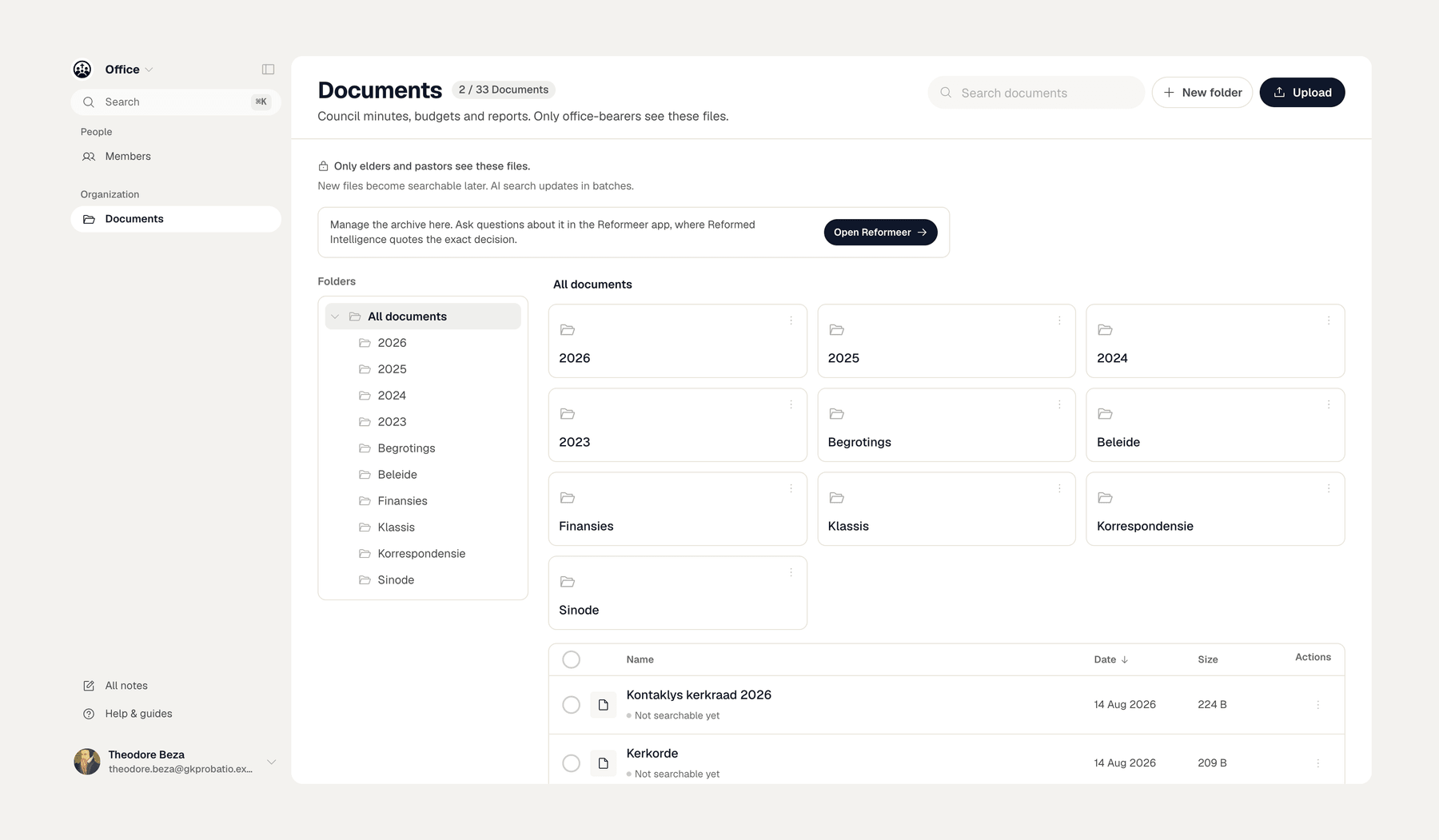
- The council documents. Folders of PDF and Word files for the active elders and the pastors only. The AI indexes them, so you can search them.
The limits: Reformeer has no meeting, agenda or minutes tool, so the minutes are uploaded files. The baptism record has no place, minister or witnesses. The screens are in Afrikaans and English. See the office features, or book a demo.
kantoor.reformeer.org
Frequently asked questions
What is the Church Order of Dort?
It is the church order that the National Synod of Dordrecht signed on 28 May 1619. It has 86 articles. Many continental Reformed federations use a church order that grew from it.
Do Presbyterian churches use the Church Order of Dort?
No. They descend from the Westminster Form of Presbyterial Church-Government (1645) and have their own books of church order. The duties of a session are close to the duties of a consistory, as the checklist shows.
Which records does the church order ask for?
Dort names only the baptism register (art. 60). Modern orders ask for a full membership record, for example CanRC art. 64, URCNA art. 50 and PCA BCO 12-8.
Published on 23 October 2026. Topic: Church order.