
Church management software keeps the member register, pastoral care, communication and finances of a church in one system, and gives each person access by role. A South African church must also check the price in rand, how members give, POPIA, and where the vendor keeps the data. Reformeer is church management software for Reformed churches in South Africa: the member register, pastoral care, attestations, church accounting and a member app, for R995 per month per church with unlimited users.
This guide is for every Reformed and Presbyterian church in South Africa, of every federation. Examples are the GKSA, the NG Kerk, the NHK, the APK and the VGK. Each federation has its own church order, so compare the checklist with your own order. Reformeer also serves Reformed and Presbyterian churches in other countries: read the guide for Reformed and Presbyterian churches.
Contents11 sections
What kind of church management software does my church need?
Answer four questions before you look at a product.
How big is your church?
A price per member grows with the church, but a flat price per church stays the same. A small church with one administrator can work with a spreadsheet for some time. A church with many wards (wyke), elders and deacons needs a system where each person sees only their part. Look for the price at your member count today and in five years.
What is your main need?
Most churches start with one main problem: the member register, pastoral care, finances, communication or a member app. If you need only the books, business accounting software can be enough. If you need members, pastoral care and finances together, look for software that keeps all three on one member register.
What is your budget in rand?
Ask each vendor for the price in rand and for every extra cost: SMS credits, card fees, the website and the data migration. Compare the cost for one year, as the council (kerkraad) will see it in the budget. Look for a price that does not grow with each new elder or deacon.
How do your people want to work?
The administrator and the treasurer work at a computer. An elder needs the ward list on a phone before a home visit (huisbesoek), and members need an app. Look for software that runs in a web browser on a computer and a phone, in Afrikaans, English or both.
What must church management software do? A 12-point checklist
Give each product a score on each point: 0 is no, 1 is partly, 2 is yes. Print the list and take it to each demo.
- Member register. Households, contact details, and a history of each change.
- Church records. Baptism, profession of faith, membership dates with a reason, and offices with dates. See church records.
- Wards and pastoral care. Wards with elders and deacons, visit notes, follow-ups, and the households not yet visited this church year. See the home visit.
- Who reads a pastoral note. Access by office and by ward, with a separate login for each person. See pastoral notes.
- Visitors and attestations. A visitor form, follow-up, and the attestation (attestaat) to the new church when a member moves. See the attestation.
- Double-entry books in rand. Every transaction balances, also per fund.
- Bank-statement import. Most church gifts in South Africa arrive as EFTs and debit orders. The software must book each gift on the bank statement to the correct member and fund.
- Card gifts. A QR code or a link, with the money paid into the bank account of the church.
- Reports for the council and the auditor. Income and expenses, a balance sheet, the budget against the actual figures, a monthly bank reconciliation, and access for the auditor. See church finances.
- Communication. SMS, email and push messages, with an opt-out for each person.
- POPIA controls and data location. Roles, a change history, backups, consent records, and the country where the vendor keeps the data. POPIA section 72 sets conditions when data leaves South Africa.
- Data migration and exit. Who moves your data in, how long it takes, and how you get it out again.
No software makes a church POPIA compliant, because the church is the responsible party for its member data (section 1). Religious belief and health are special personal information (section 26). A church may process the religious beliefs of its own members (section 28). For health details in a pastoral note, consent is the safe route. Ask a lawyer about your own case.
Spreadsheet, accounting software or church management software: which fits?
Each category is the right choice for some churches:
- A spreadsheet fits a very small church with one careful administrator and no confidential notes. It cannot limit a person to one ward, so each person with the file sees all of it.
- Business accounting software fits a church that needs only the books. It does double-entry well, but it has no member register or pastoral care.
- Generic church software fits a church where a pastor leads a team of staff and volunteers. It often does child check-in and attendance well, but usually not wards or attestations.
- Software built for a Reformed church fits a church that a council governs under a church order. It may not do child check-in. See Reformed church management.
The table shows what each category usually does.
| Checklist point | Spreadsheet | Accounting software | Generic church software | Reformed church software |
|---|---|---|---|---|
| Baptism, profession and membership dates | By hand | No | Custom fields | Yes |
| Wards with elders and deacons | By hand | No | Groups, not wards | Yes |
| Pastoral notes by office and ward | No | No | Partly | Yes |
| Visitors and attestations | By hand | No | Visitors only | Yes |
| Double-entry books per fund | By hand, no check | Yes | Partly | Check |
| Bank-statement import per member | No | No member link | Partly | Check |
| Reports for the council and the auditor | By hand | Yes | Gift reports | Check |
| Child check-in and attendance at services | By hand | No | Often | Often not |
How much does church management software cost in South Africa?
Vendors use three price models:
- A price per member: the cost grows with the church.
- A price per user: each login costs money, so a council may share one login. Then nobody can tell who read a pastoral note.
- A flat price per church: one price for every church size and every user.
This worked example uses an example price, not the price of a real product. At R4 per member per month, a church of 400 members pays R1 600 per month, and a church of 150 members pays R600. At a flat R995 per month, the larger church pays less and the smaller church pays more. The two models cost the same at about 250 members.
Reformeer has a flat price: R995 per month per church, with unlimited users, for Kantoor, Finansies and the member app. With the church website, the price is R1 495 per month. That is R11 940 or R17 940 per year.
Add the extra costs: SMS credits, card fees and the time of your own people. At Reformeer, one SMS costs R0.60, so one message to 300 households costs R180.
What must you ask a vendor before you sign?
Get each answer in an email.
- In which country do you keep our data and backups, and which other companies process it?
- Who can read a pastoral note: an administrator with no office, or your own staff?
- Who does the data migration, how long does it take, and what does it cost?
- If we leave, can we take all our data out in a format that we can open?
- Is there a contract, and what is the notice period?
- What does one SMS cost?
- Does the ledger balance per fund? Can you show us a bank reconciliation?
- What does our auditor get?
- Into whose bank account does the money from card gifts go?
- Do you offer two-factor sign-in?
- Who helps us when there is a problem, and in which language?
How Reformeer does it
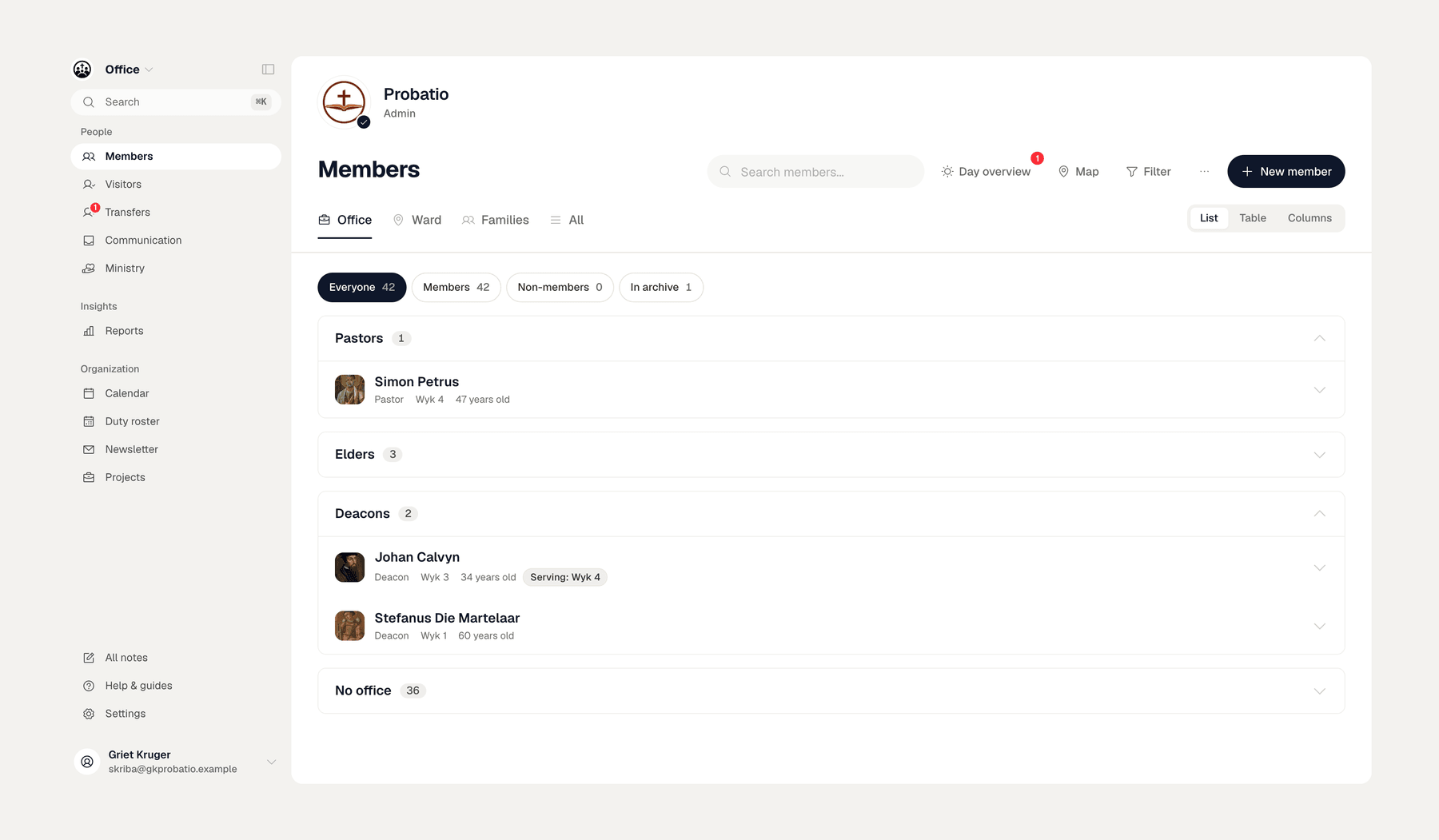
Reformeer has three web apps: Kantoor (the church office), Finansies (church accounting) and the member app at www.reformeer.org. The screens are in Afrikaans and English. Per point on the checklist:
- Register (points 1 and 2). Households, membership periods with join and exit reasons, baptism and profession dates, offices with dates, and custom fields. An administrator with write access confirms each edit by an office-bearer or a member.
- Pastoral care (points 3 and 4). A note is a Note, a Visit or a Call. The writer chooses who reads it: Elders only (the member's ward elders and the pastors), Elders and deacons, a ministry group, or Administrative. An administrator with no office never reads pastoral notes. The Day overview lists the households in your wards with no visit note this church year.
- Visitors and attestations (point 5). A visitor form with a QR code, Admit, and transfers: the new church requests, and the old church releases. A church that is not on Reformeer gets the request by email. Attestation letters are PDFs.
- Finances (points 6 to 9). The double-entry ledger refuses a transaction that does not balance, also per fund. Finansies imports the bank statement (PDF, CSV, XLS or XLSX) and suggests the account, the fund and the member for each line. A finance person approves each line, and the EFT and debit-order gifts then reach each member's contribution statement. Card gifts go to the church's own Paystack subaccount: Reformeer takes no fee, and the church pays the Paystack fee. It also has a monthly bank reconciliation, a budget, a council report, a month close and read-only auditor access.
- Communication (point 10). SMS to one person or in bulk (R0.60 per SMS), email to one person, and news posts with push messages. Each person can opt out of SMS and push.
- POPIA and data (point 11). Roles, a data agreement that each office user accepts, a change history and daily backups. The database and the files are in Belgium (Google Cloud), and the applications run in Germany (Vercel). Reformeer AI runs at Anthropic in the United States. Reformeer is built with POPIA controls.
- Data migration (point 12). The Reformeer team imports your export (Excel, CSV and similar) with the church, in about 1 to 2 days. It is not self-service. The register exports to Excel, and the finance reports to PDF or Excel.
Reformeer does not do child check-in, attendance at services (only the catechism roll call), room booking or payroll. It has no bank feeds: you import the statement as a file. It does not collect debit orders, issue SARS section 18A certificates, send WhatsApp messages or offer two-factor sign-in. Weigh these limits before you choose.
See the prices, read about Kantoor and Finansies, or book a demo.
kantoor.reformeer.org
Frequently asked questions
What is the best church management software in South Africa?
It depends on the church. Generic church software fits a pastor-led church that needs child check-in, and business accounting software fits a church that needs only books. A Reformed or Presbyterian church with a council, wards and attestations fits software built for that structure, such as Reformeer.
How much does church management software cost in South Africa?
Vendors charge per member, per user or a flat price per church. Reformeer costs R995 per month per church with unlimited users, or R1 495 per month with the church website.
Is church management software POPIA compliant?
No software makes a church compliant, because the church is the responsible party for its member data. Reformeer is built with POPIA controls, and the church must still register its own Information Officer.
Can we move our data from our current system?
Yes, if your current system exports to Excel or CSV. At Reformeer, the team imports the export with the church in about 1 to 2 days.
Can church management software issue section 18A certificates for tithes?
SARS says that tithes and offerings for the religious activities of a church do not qualify for a section 18A deduction (guide IT26). Reformeer does not issue section 18A certificates, and its contribution statements contain no tax text.
Published on 23 October 2026. Topic: Church management.